Confirming the exact cost of a garage door repair before any work begins removes guesswork from the final bill and gives both sides something concrete to reference. Bypassing this step leaves no reference point if the price changes once a technician arrives, which happens more often than most homeowners expect.
Specific reasons make a written quote worth requesting on every service call, not just larger repairs involving major parts or full replacements. This guide breaks down what a proper quote includes, why companies sometimes avoid providing one, and how to use it to compare repair companies before choosing where to spend the money.
Key Takeaways
- Written quotes confirm the full scope of work before any repair begins.
- Verbal-only pricing removes the paper trail needed to dispute a charge.
- Legitimate companies rarely hesitate to provide written documentation.
- Comparing quotes from multiple companies helps you find fair market pricing.
- A quote protects against price changes once a technician is on-site.
What Counts as a Proper Written Quote?
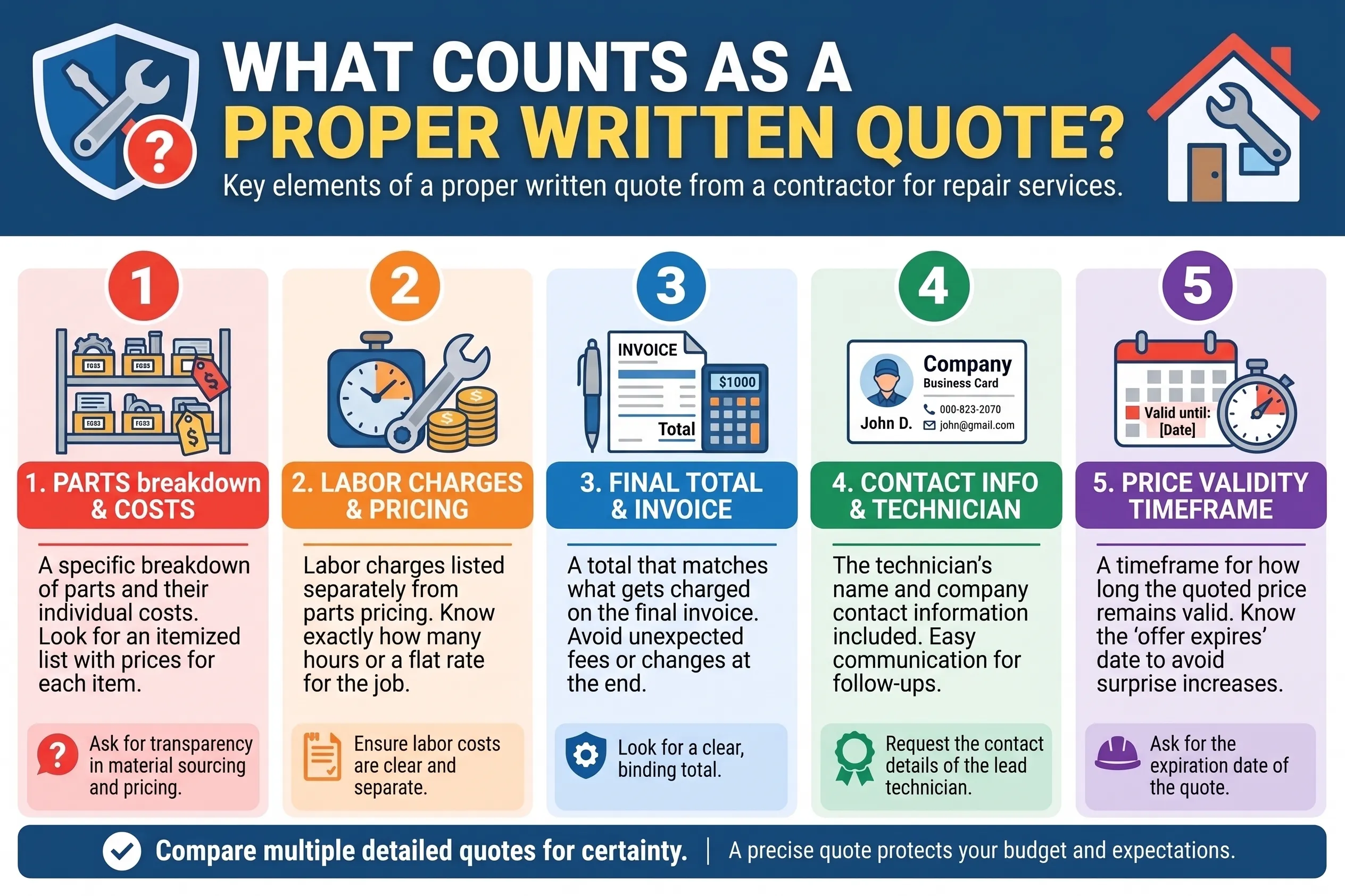
Proper written quotes list every part, labor charge, and total cost before any technician touches the door, giving both sides a clear, shared reference from the start.
These elements separate a real quote from a verbal estimate:
- A specific breakdown of parts and their individual costs.
- Labor charges listed separately from parts pricing.
- A total that matches what gets charged on the final invoice.
- The technician’s name and company contact information included.
- A timeframe for how long the quoted price remains valid.
Requesting these details in writing before approving anything protects against confusion once the repair begins, especially if a dispute comes up later.
When Should a Written Quote Be Provided?
Garage door installation and repair work should end with a written quote before any technician arrives on-site to begin the actual job.
A few specific moments call for this documentation:
- Immediately after a technician completes the initial diagnosis.
- Before ordering any parts or starting replacement work.
- Once the scope of the repair becomes clear during inspection.
- Prior to scheduling a follow-up visit for larger repairs.
- Before requesting any deposit or partial payment.
Getting this documentation early removes ambiguity from every conversation that follows, from the first phone call through the final invoice.
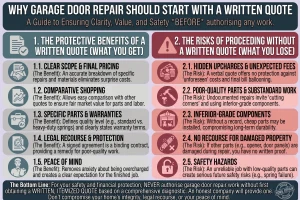
Why Is a Written Quote Required Before Any Garage Door Repair?
Written quotes matter because they turn a verbal promise into something a homeowner can hold a company accountable to.
Reason | What It Protects | Why It Matters |
Confirms the Full Scope of Work | Against incomplete or misunderstood repairs | Both parties agree on what work is actually included |
Protects Against Price Changes Mid-Repair | Against a total that grows once work starts | The quoted price stays fixed unless new issues arise |
Creates a Paper Trail for Disputes | Against unresolved billing disagreements | Written documentation supports any formal complaint |
Forces a Real Diagnosis Before Pricing | Against guesswork disguised as an estimate | An accurate quote requires an accurate diagnosis first |
Establishes Accountability for the Company | Against vague or shifting responsibility | A signed quote ties the company to its own pricing |
Comparing a quote against standard pricing ranges helps confirm whether the numbers actually reflect fair market cost for the same repair.
Confirms the Full Scope of Work
Written quotes spell out exactly which parts and labor the repair covers, leaving no room for later disagreement between the homeowner and the technician.
These details typically define the scope clearly:
- Every part expected to need replacement during the visit.
- The specific labor tasks included in the quoted price.
- Any additional work that would require separate approval.
- The expected timeframe for completing the repair.
- Warranty terms tied to the parts and labor performed.
Both sides working from the same written scope prevents confusion once the repair actually begins, no matter how the job unfolds.
Protects Against Price Changes Mid-Repair
Locking in pricing before work begins prevents a technician from raising the total once the job is already underway and harder to walk away from.
Fixed quotes typically protect against these changes:
- A sudden increase in labor cost partway through the repair.
- Additional parts added without a clear explanation.
- A revised total presented with no itemized breakdown.
- Pressure to approve the increase to finish the job.
- Vague justifications for why the price grew significantly.
Fixed pricing removes the leverage a dishonest technician would otherwise have mid-repair, once the door is already partly disassembled.
Creates a Paper Trail for Disputes
Documentation matters most once a disagreement over pricing or workmanship actually happens after the repair finishes and the invoice arrives.
Written quotes support a dispute in these specific ways:
- Proof of the agreed price before any work began.
- A reference point if the final invoice does not match.
- Evidence to support a complaint with a consumer agency.
- Documentation for a credit card dispute if needed.
- A record showing what the company originally promised.
Having this paper trail available turns a disagreement into a documented, resolvable issue instead of a drawn-out argument.
Forces a Real Diagnosis Before Pricing
Accurate quotes cannot exist without a technician first confirming what actually needs repair on the door, instead of pricing off a quick guess.
This connection between diagnosis and pricing shows up clearly:
- A quote naming the exact part responsible for the issue.
- Pricing that reflects the specific repair, not a general estimate.
- Documentation showing what testing led to the quoted price.
- A total that changes only if the diagnosis changes too.
- Confidence that the price reflects the real problem, not a guess.
Real diagnosis behind the numbers gives the quote genuine credibility, something a rushed estimate rarely offers.
Establishes Accountability for the Company
Signed, written quotes tie a company to its own pricing in a way a verbal promise never fully does, especially once the job is already scheduled.
Accountability shows up through several specific details:
- A named technician responsible for the work performed.
- Company contact information included directly on the quote.
- A total the company cannot easily deny having offered.
- Terms that hold up if a dispute reaches a consumer agency.
- A document that discourages price changes without explanation.
Written accountability protects homeowners long after the technician leaves the driveway and the job is already finished.
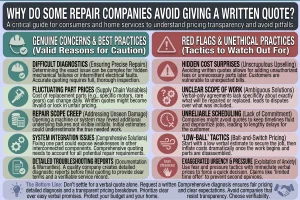
Why Do Some Repair Companies Avoid Giving a Written Quote?
Verbal-only pricing sometimes replaces documentation entirely, leaving homeowners with nothing to reference once the work begins.
These reasons tend to explain the avoidance:
- Verbal pricing allows the total to shift without accountability.
- If a dispute happens later, no paper trail exists, such as one tied to a garage door spring repair.
- Vague pricing makes it easier to add unexplained charges.
- Documentation would expose inconsistent pricing between customers.
- A written quote creates a record a company would rather avoid.
To understand exactly how this avoidance connects to a broader pattern of unclear estimates, read our guide on What Should a Legitimate Quote Always Include?, which breaks down what documentation should look like by comparison.
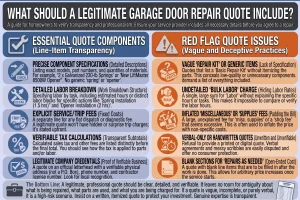
What Should a Legitimate Quote Always Include?
Checking a quote against typical scam warning signs helps confirm whether the pricing structure matches honest industry practice, not a rushed sales pitch.
Legitimate quotes consistently include these details:
- An itemized breakdown of every part and its individual cost.
- Labor charges listed clearly, separate from parts pricing.
- The technician’s name and verifiable company contact information.
- A total that will not change without prior written approval.
- Terms explaining what happens if the repair scope changes.
To trace exactly why some companies avoid providing this level of detail in the first place, read our guide on Why Do Some Repair Companies Avoid Giving a Written Quote?, which covers the specific motivations behind that avoidance.
How to Use a Quote to Compare Repair Companies
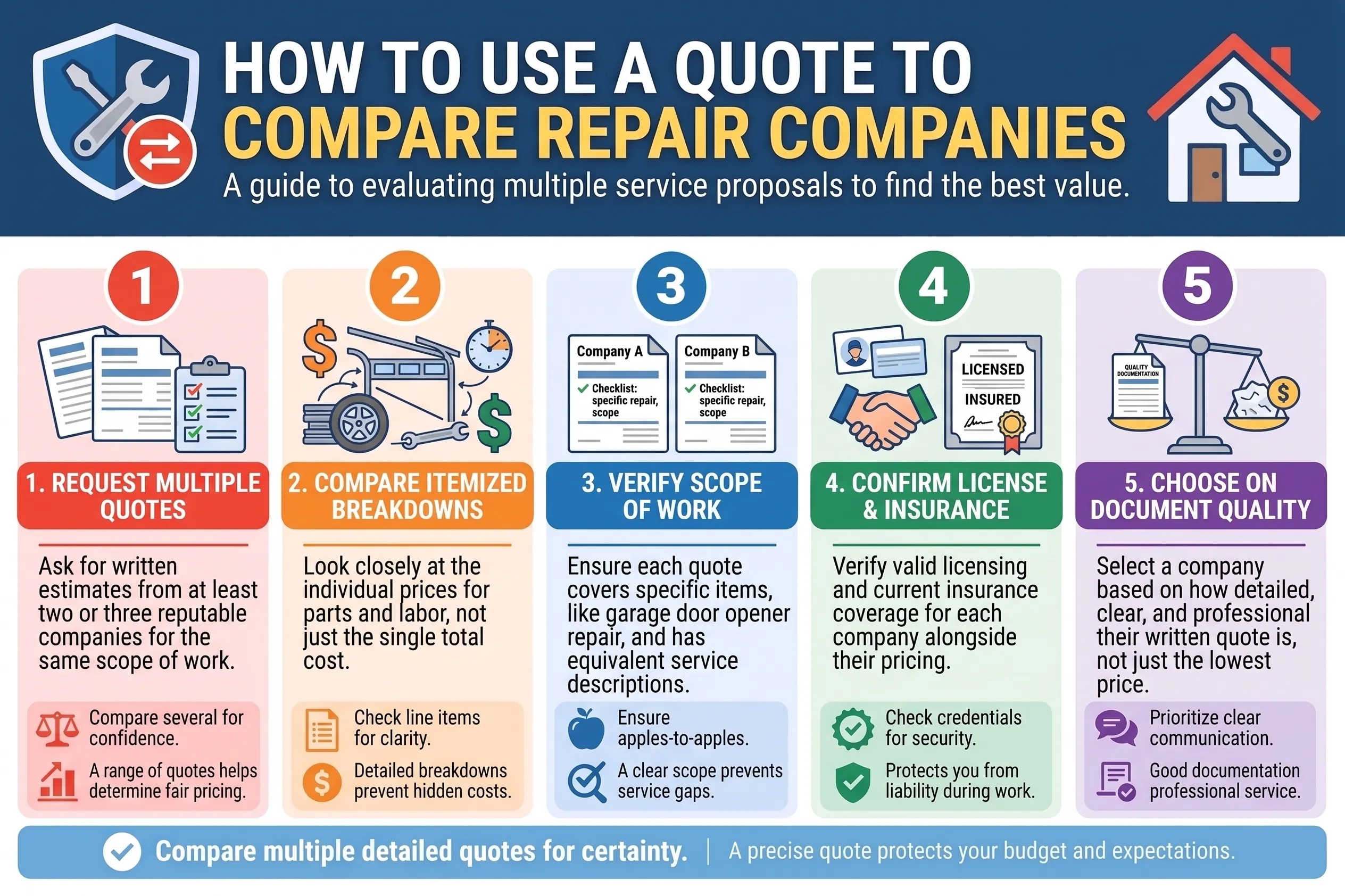
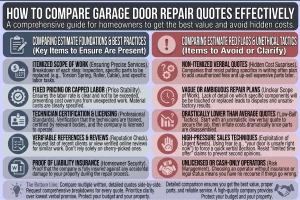
Written quotes give homeowners something concrete and specific to compare before committing to any single company or price.
Useful comparisons typically follow these steps:
- Request quotes from at least two or three different companies.
- Compare the itemized breakdown, not just the total cost.
- Check whether each quote covers garage door opener repair or a similarly specific repair.
- Confirm licensing and insurance status alongside the pricing.
- Choose based on documentation quality, not price alone.
To walk through the specific method for lining up quotes side by side, read our guide on How to Compare Garage Door Repair Quotes Effectively, which covers what to check first before choosing a company.
A Written Quote Protects Every Garage Door Repair Decision
The reasons covered throughout this guide trace back to the same principle: documentation protects both the homeowner and the company doing the work. Requesting a written quote before any repair begins turns an uncertain decision into one backed by real accountability.
Royale Garage Door Service provides homeowners throughout Mission Viejo with fully itemized written quotes, no matter how small the job might seem at first or how far along the visit already is. Contact us or give us a call today, and let our trained team put every detail in writing before asking for approval.